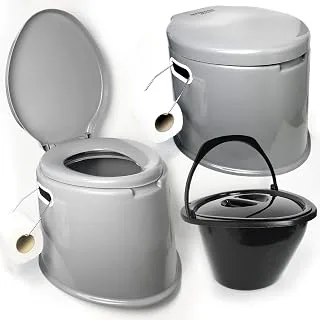
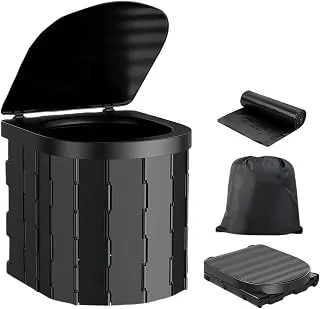
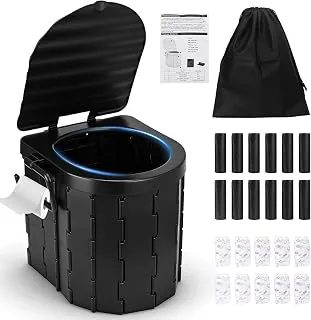
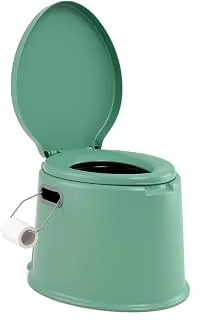
A compact toilet must fit more than its storage cupboard. You need room to sit, reach the controls, separate or remove the waste tank and move it out of the vehicle. Start with that routine before choosing a capacity or a brand.
This guide uses manufacturer examples to compare arrangements. It does not claim a hands-on test, absence of odours or a guaranteed interval between emptying.
Portable and cassette arrangements
A self-contained portable toilet can be removed from its storage position for use and servicing. A cassette toilet is installed as a fixture with a removable holding tank. Thetford's product overview distinguishes these categories; the region-specific models and instructions still need checking for a UK purchase.
For a small conversion, sketch where the toilet will live while driving and where it will be used. Include privacy and access to exits. A permanent installation should be planned with the vehicle layout rather than added solely because its visible seat looks compact.
Compare two portable examples
The Thetford portable-toilet brochure lists these nominal dimensions:
| Model | Height × width × depth | What the comparison tells you |
|---|---|---|
| Porta Potti 145 | 330 × 383 × 427mm | A medium-sized portable arrangement |
| Porta Potti 335 | 313 × 342 × 382mm | A smaller external footprint and a lower seat |
Check the current drawing before ordering. These are product outlines, not all the space required for operation, fixings or removal.
Thetford's UK-facing portable range also distinguishes pump and model options. Make sure the listing identifies the exact toilet, rather than a carry bag or accessory with a similar name.
Mock up both storage and use
Make a cardboard footprint and try it in the intended location. Add the lid movement and the space your knees and feet need. Check whether another person can pass through the van when it is in use.
Rehearse the removal path. A narrow cupboard opening or furniture lip can matter more than the internal cupboard dimensions. Ask how the selected unit can be secured for travel and verify any hold-down kit's exact compatibility.
Plan emptying before the first night
Identify an appropriate chemical-toilet disposal facility and confirm its conditions. Follow the toilet and treatment-product instructions, including the receiving facility's requirements. Do not treat a surface-water drain, roadside or ordinary outdoor area as an emptying point.
The number of days between emptying depends on the unit and use. Plan around access to facilities rather than a universal “week-long” claim. Consider the weight you will actually need to lift and carry.
When a cassette installation makes sense
Investigate a cassette toilet when a dedicated space and service access are part of the build. Include installation, access arrangements and maintenance in the comparison. The removable tank's path still matters even though the seat remains fixed.
For a flexible layout, a portable unit may be the simpler starting point, provided it can be used and transported appropriately.
Sources checked on 25 October 2026. Product examples are not a claim of universal suitability.